Warm Up Your Designs with Authentic Coffee Backgrounds
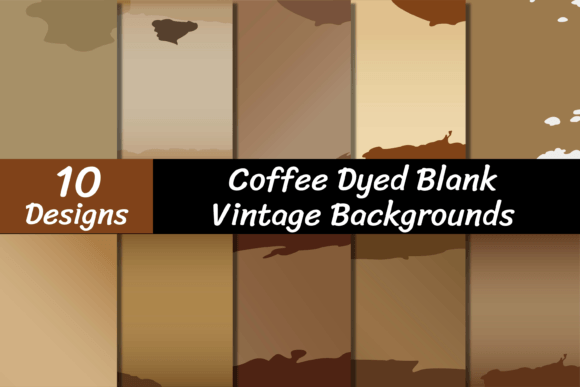
There’s a specific feeling you get from a well-worn café table or the stained interior of an old leather-bound book. It’s a sense of history, warmth, and tactile reality that digital screens often lack. If you’re trying to bridge that gap between the sterile digital world and the rich texture of physical reality, you need design assets that do more than just fill space. This collection of Coffee Backgrounds is designed specifically to solve that problem, offering a set of 10 distinct coffee-dyed blank vintage backgrounds that act as a foundation for storytelling.
These aren't just generic textures. They are digital papers crafted to mimic the organic, unpredictable nature of coffee staining. The visual character is defined by its sepia tones, the gentle bleeds of the "dye," and the imperfections that make vintage items so charming. When you use a background like this, you are instantly setting a mood. It suggests heritage, craftsmanship, and a slower pace. For a designer or entrepreneur, this is a powerful tool. Instead of starting with a blank white canvas, which can feel clinical, you start with a canvas that already has a soul. This makes Coffee Backgrounds an essential asset for anyone working on projects that require a touch of authenticity.
Practical Applications for Modern Creatives
The versatility of these vintage coffee backgrounds is where they truly shine. Because the included files come in high-resolution formats (6000 x 4000 pixels in AI, EPS, JPG, PNG, SVG, and PDF), they are adaptable for almost any medium. The key is understanding where the "coffee-dyed" aesthetic adds the most value.
For packaging design, particularly for artisanal goods like roasted coffee beans, baked goods, or handmade soaps, these backgrounds provide an immediate visual shorthand for "natural" and "small-batch." Instead of relying on complex illustrations, you can use a clean Coffee Background to let your typography and logo design take center stage. The texture does the heavy lifting, conveying the brand identity before the customer even reads a word.
In editorial design and publishing, these assets are invaluable. If you are a blogger or publisher creating content about history, travel, or lifestyle, a coffee-stained paper can serve as a beautiful backdrop for pull quotes or chapter dividers. It breaks up the monotony of standard text blocks and adds a layer of visual interest. However, a word of caution: readability is paramount. When placing text over these textured papers, ensure there is enough contrast. A bold sans serif font usually works best here, as the clean lines of a modern typeface cut through the organic noise of the background, maintaining a clear visual hierarchy.
For social media graphics, especially on platforms like Instagram or Pinterest where aesthetic cohesion is vital, these backgrounds are a game-changer. Small business owners and content creators can use them to create a consistent, warm feed. Whether you are announcing a sale, sharing a testimonial, or posting a recipe, the vintage coffee paper acts as a unifying element. It helps with brand recognition; followers will start to associate that specific warm, textured look with your content, even before they see your logo.
Integrating Texture into Your Brand Strategy
Choosing to use a textured background is a strategic decision that impacts your entire brand identity. It moves your brand away from "corporate" and toward "boutique." When evaluating whether these Coffee Backgrounds fit your project, consider the personality you want to project. If your brand voice is warm, nostalgic, educational, or artisanal, this is a perfect match. If your brand is ultra-modern, tech-focused, or minimalist in a cold, sterile way, a coffee-dyed paper might create a conflicting message.
One of the most effective ways to use these assets is in font pairing. The vintage texture of the background pairs beautifully with specific typography styles. For a rustic, authentic look, try pairing the background with a script font or a handwritten font for headers, but keep it legible. For a more sophisticated, editorial approach, use a sharp serif font. The contrast between the organic background and the structured letterforms creates a dynamic tension that is visually appealing. Avoid using overly decorative or "fancy" fonts that might get lost in the texture; legibility should always be your guide.
Furthermore, consider the practical workflow. The files are provided in vector formats (AI, EPS, SVG) as well as raster (JPG, PNG). If you are working on web design, the high-resolution JPGs are excellent, but remember to optimize them for web performance so they don't slow down your site load times. For print projects—like wedding invitations, menus, or business cards—the PDF and AI files ensure that the texture prints crisply without pixelation. This attention to quality makes them a true premium font asset (or rather, premium design asset) rather than a disposable freebie.
Maximizing Your Investment in Design Assets
When you download this pack, you aren't just getting ten images; you are getting a toolkit for rapid prototyping and production. Because these are blank vintage backgrounds, they are incredibly flexible. You can use them as a base for a complex collage, or simply add a watermark for a quick social post. The fact that they come zipped is standard for high-quality digital assets, so ensure you have unzipping software like WinZip or Winrar ready to access your files quickly.
To get the most out of these Coffee Backgrounds, treat them as a starting point for your creative font choices. Don't be afraid to experiment with opacity. Sometimes, lowering the opacity of the background or overlaying a semi-transparent white box can create a "frosted glass" effect that still hints at the vintage texture underneath while making text much easier to read.
Ultimately, these coffee-dyed digital papers are about evoking a feeling. They help you create marketing materials, digital content, and physical products that feel lived-in and real. By incorporating these assets into your workflow, you save time on creating textures from scratch and ensure a level of consistency across your projects. Whether you are designing a logo for a local café, creating a digital planner for sale, or crafting a newsletter for your subscribers, the warmth of a vintage coffee background can transform a standard layout into something memorable.